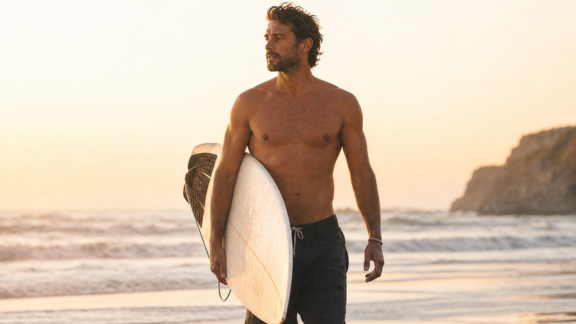
There is a particular kind of guy at the Beaches who does not think low testosterone applies to him. He paddles out before work, plays golf most weekends, lifts four days a week, and has looked roughly the same for a decade. When his energy drops and recovery starts taking three days instead of one, the first explanation he reaches for is age, or overtraining, or a bad stretch of sleep.
Sometimes that is exactly what it is. Sometimes it is not. Fitness does not rule out low testosterone, and in a few specific ways an active lifestyle can actually contribute to it.
Why fit men still get low results
Chronic under-recovery. Training hard without matching recovery keeps cortisol elevated. Sustained high cortisol suppresses the hormonal axis that drives testosterone production. The men most at risk here are the ones training hardest with the least deload.
Sustained caloric deficit. Low energy availability, meaning consistently eating less than training demands (our TDEE calculator gives you a rough baseline to compare against), is a well-documented suppressor of reproductive hormones in men. Cutting for a race, a trip, or just staying lean year-round can do it.
Sleep debt. Testosterone is produced largely during sleep. Short or fragmented sleep lowers it measurably: in a University of Chicago study, healthy young men restricted to under five hours a night for one week showed significantly lower daytime testosterone (Leproult R, Van Cauter E. Effect of 1 Week of Sleep Restriction on Testosterone Levels in Young Healthy Men. JAMA. 2011;305(21):2173-2174.). The 4:45am alarm for a dawn patrol session at the pier, five days a week, is not free.
Alcohol. At the Beaches, drinking is woven into the social calendar in a way it is not everywhere else. Chronic intake suppresses testosterone production directly.
Body composition is a bad proxy. You can be lean, strong, and visibly fit with a total testosterone in the 200s. A lean body mass calculator tells you about your composition, not your endocrine function. Appearance tells you very little about your endocrine function.
The symptom that usually shows up first
For active men, the earliest signal is almost never libido or body composition. It is recovery time.
Sessions that used to take a day to bounce back from take three. Soreness lingers. Performance plateaus or slips despite the same or greater effort. Motivation for training, specifically, starts to erode, which active men often misread as burnout.
Other symptoms follow: fatigue that sleep does not resolve, mental fog, flattened mood, reduced libido, fewer morning erections, and slow accumulation of abdominal fat despite unchanged habits.
How this actually gets diagnosed
Two things must both be true. You need symptoms consistent with testosterone deficiency, and you need biochemical confirmation.
Per the AUA guideline on testosterone deficiency, the threshold is a total testosterone below 300 ng/dL, and the diagnosis should be made only after two separate measurements, both drawn in the early morning, on different days. Testosterone peaks in the morning and declines through the day, so an afternoon draw after a workout tells you very little.
For active men, one additional detail matters: do not test the morning after a hard session or a heavy night. Acute training stress and alcohol both move the number. Test on a normal day.
If testosterone comes back low, LH should be measured to distinguish a testicular cause from a pituitary one. A full initial panel includes total and free testosterone, LH, FSH, SHBG, estradiol, CBC with hematocrit, CMP, lipids, and PSA where age-appropriate.
Want a real answer instead of a guess? Call Slym Wellness at 904-788-3747. Our Jacksonville office is roughly 20 to 30 minutes from Jacksonville Beach, Neptune Beach, Atlantic Beach and Ponte Vedra depending on traffic, and virtual visits are available throughout Florida if you would rather skip the drive entirely.
What treatment looks like, and what it does not do
If you meet the diagnostic criteria, treatment involves a starting protocol, medication, and ongoing monitoring of your labs and symptoms. Dose gets adjusted based on how you respond.
Two things worth being direct about.
This is replacement, not enhancement. The goal is restoring physiologic levels, not pushing them above the normal range for performance. Supraphysiologic dosing carries a different and larger risk profile, and it is not what a legitimate medical program provides.
If you compete, check your governing body’s rules. Testosterone is a prohibited substance in most tested sport. A therapeutic use exemption is a separate process with its own documentation requirements, and it is not automatic. Sort this out before starting, not after.
Risks worth knowing
- Fertility. TRT suppresses sperm production and can cause infertility that sometimes persists after stopping. Raise this before you start if children are in the plan.
- Erythrocytosis. Testosterone can raise hematocrit. This is why monitoring is not optional.
- Sleep apnea. Can worsen existing apnea.
- Prostate. Not for men with metastatic prostate cancer. Ongoing monitoring for men with significant urinary symptoms.
- Other. Acne, oily skin, testicular shrinkage, mood changes, injection site reactions.
And the one that applies most often at the Beaches: if your labs come back normal, testosterone is not your problem. Sleep, recovery, alcohol, and training structure are where the answer probably lives, and a good provider will say so rather than writing a prescription anyway.
Getting started
Slym Wellness sees patients in person at our Jacksonville office and virtually across Florida. Men come to us from Jacksonville Beach, Neptune Beach, Atlantic Beach, Ponte Vedra Beach, Sawgrass, and along the A1A corridor.
Because proper testing requires early-morning draws, we schedule first-appointment slots specifically so you can get labs done before work.
This article is general information, not medical advice. Discuss your situation with a qualified provider.
Sources
Frequently Asked Questions
I work out five days a week. Can I still have low testosterone?
Yes. Fitness does not rule it out, and heavy training combined with under-recovery, sustained caloric deficit, or short sleep can contribute to lower levels. Body composition is a poor proxy for endocrine function.
What is usually the first sign for an active guy?
Recovery time. Sessions that used to take a day to bounce back from start taking two or three, soreness lingers, and training motivation erodes. These typically show up before libido or body composition changes.
Should I avoid testing after a hard workout?
Yes. Acute training stress can lower a testosterone reading, as can alcohol the night before. Test on a normal morning rather than after a hard session or a late night.
Do you have an office near Jacksonville Beach?
Our physical office is in Jacksonville, roughly 20 to 30 minutes from the Beaches depending on traffic. Virtual visits are available throughout Florida, and labs can be drawn at a site near you.
Will TRT affect my endurance training?
Responses vary by individual and your provider will monitor how you respond. The relevant concern for endurance athletes is hematocrit, which testosterone can raise, and which requires ongoing lab monitoring.
Will testosterone show up on a drug test for competition?
Testosterone is a prohibited substance in most tested sport. A therapeutic use exemption is a separate process with its own requirements and it is not granted automatically. Check with your governing body before starting.
Does drinking affect my testosterone?
Chronic alcohol intake suppresses testosterone production. It also disrupts sleep quality, which compounds the effect since testosterone is produced largely during sleep.
What if my labs come back normal?
That is useful information, because it redirects the search toward sleep, recovery, training load, thyroid function, or alcohol intake. A provider who prescribes testosterone anyway is not doing you a favor.
Related reading